
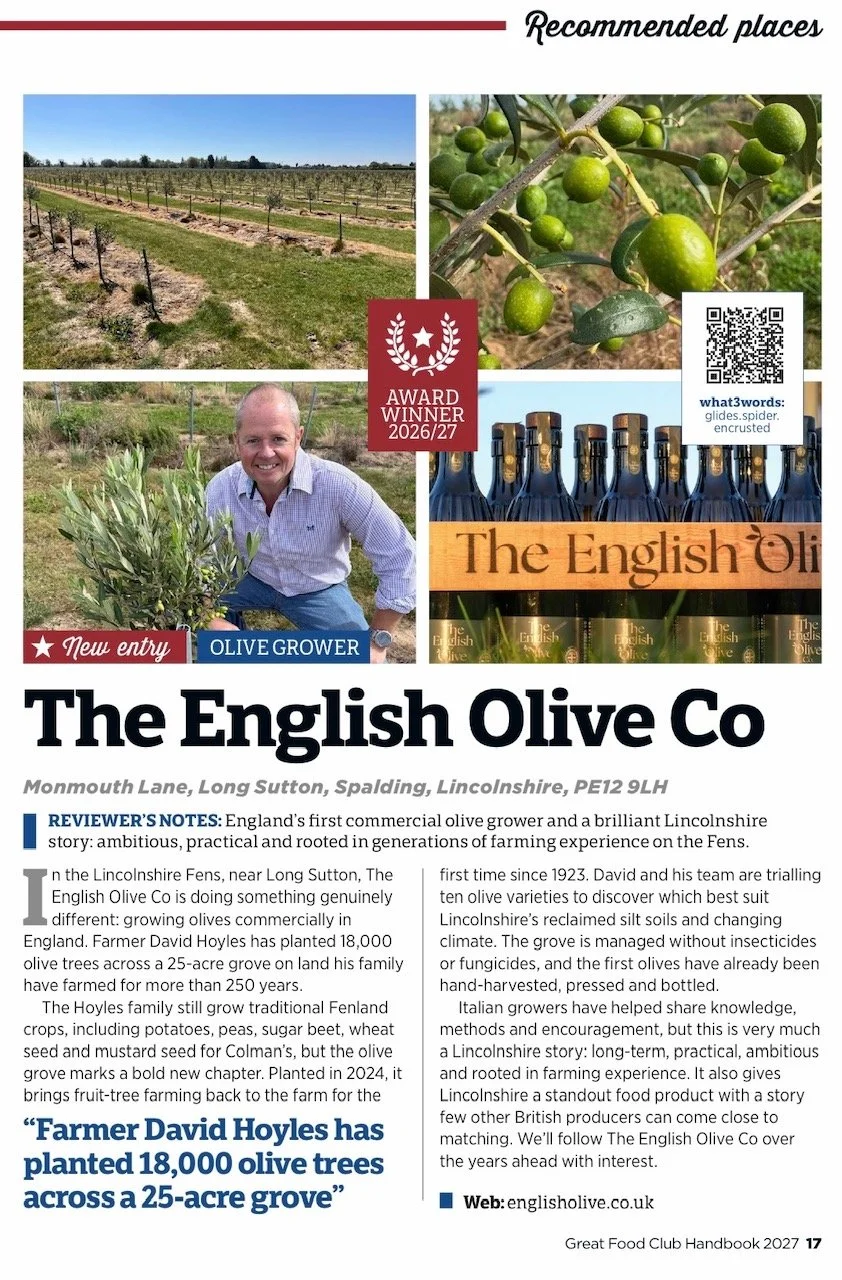
Olive harvest 2026 has started with some hand picking and some harvested by a self propelled machine! The trees enjoyed a good summer and have grown and fruited well, and we will soon be filtering and bottling the oil. We were also very honoured to win the Great Food Club Food Producer of the Year award at the start of the month; lovely recognition for the teams hard work in the olive grove.
Welcome to you all, and especially to our new newsletter subscribers, with this months newsletter giving you updates on what we have been up to in October. This month is one of the most rewarding after the hours of care and attention in the olive grove leads to the start of the harvest period, which will last two months for us. Exciting and nervous times!
At the start of the month we were very honoured to be awarded The Great Food Club 2026/27 Food Producer of the Year award. This award is voted by the clubs members and the judges. We were proud to be shortlisted as a finalist in June, and are now super proud to be announced at the category winner. Well done to the other three finalists in our category, and congratulations to all the other award recipients.
Matt and Phillip from the Great Food Club came back to the olive grove at the end of the month to present David with the winner plaque, carved in English oak. Thank you all for voting and we will continue to give the olive grove our best efforts to be successful and fruitful.
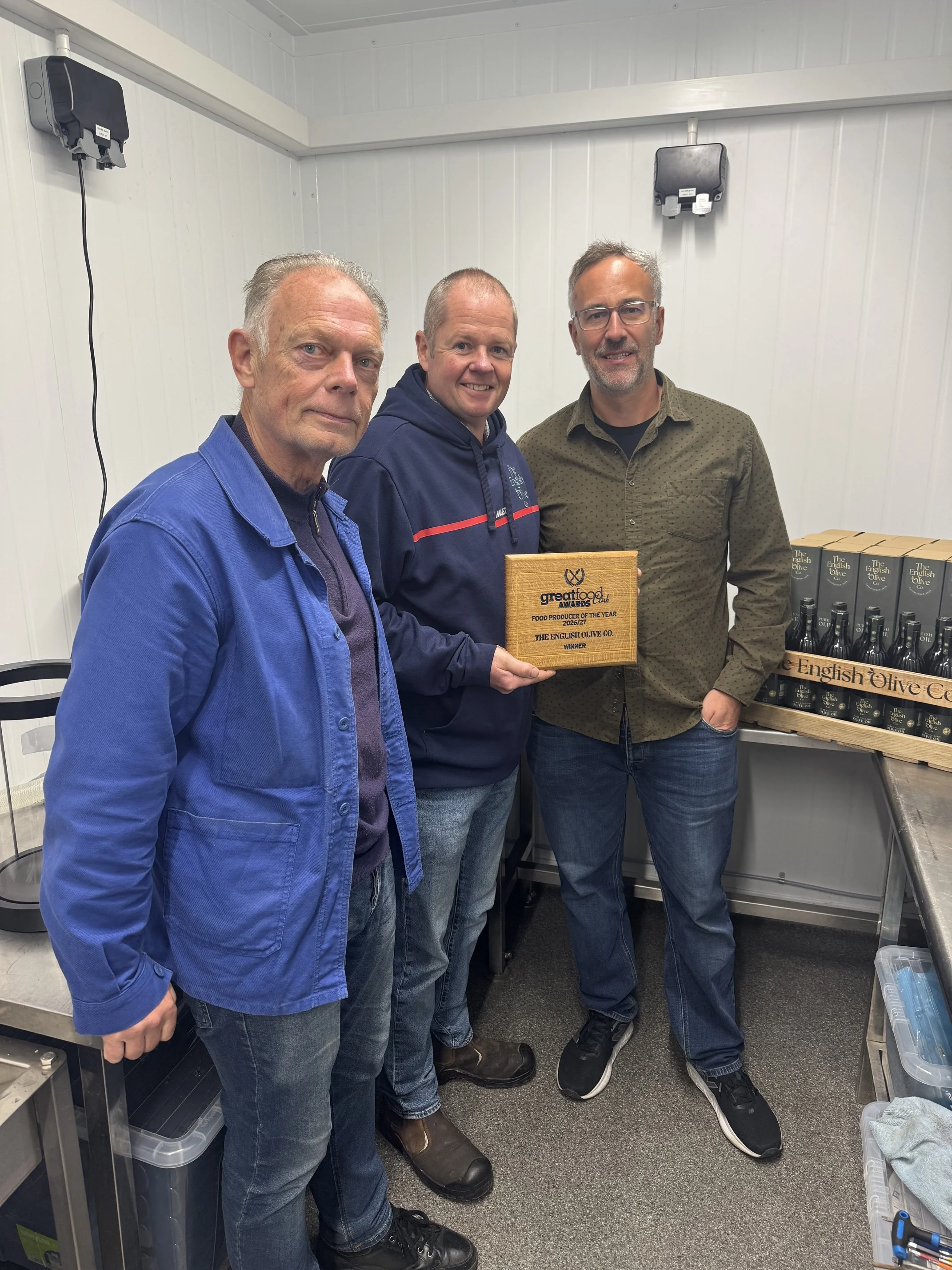

Matt and Phillip of the Great Food Club presenting David with 2026/27 Food Producer of Year Award
In the middle of October one earlier maturing olive tree variety had the fruit changing colour and the birds taking a liking to it, so nature was telling us it was about ready to harvest! Most olives will turn in ripeness from green, to blushed, to burgundy to black, but it is unlikely the UK weather will allow our fruit to get too ripe before being lost to storms or frosts! Harvesting the olives at the start of their maturity gives maximum health benefits in the oil, but does reduce the oil content of the olives - a simple compromise of quality over quantity. Our hand is dealt on the quantity side, because as mentioned, our olives will never get too blushed or burgundy, but it does mean that we should get better quality oil if we mill the olives within hours after harvest. We may get 10% olive oil from our olives, unlike many Mediterranean oils where their more blushed crops may get nearer 15% olive oil extracted.
In order to test the olive mill line we wanted to put a small batch of olives through to help remind ourselves of some of the skills and knowledge transfer that Serkan taught us last year. Serkan’s family manufacture olive mills and had sold their equipment to 31 countries, and with our purchase of a washer, mill, decanter, filter and various storage containers, the UK became his 32rd country! Connor and David had made notes, taken videos and watched various reminders on the internet on how to operate the milling line ahead of this season, but it is still a nervous time!
A small batch of olives was hand harvested by the farm team and family so that the pressure of a big volume of olives that needed milling was reduced, and we could learn to get the best oil from this years harvest. Milling olives is a craft and a skill, and less of a science. The ripeness of the olive, the weather preceding the harvest, the day temperature at milling, the olive variety, and many many more variables play a factor in trying to get the best olive oil from the crop, and extracting as much of that oil. The skill and knowledge of the miller is often passed down generation after generation, but Connor and David only have one years experience to go on! They put all their knowledge and efforts into it, and were pleased with the first batch outcome.
Having had a positive result with the hand harvested crop and with plenty of olives on this particular tree variety, then faster harvest was needed to get the crop in safely at optimum timing, so a self propelled harvester was the answer! Nigel from Norfolk has a large blackcurrant business and he uses a Braud self propelled harvester to gather in his crop, before going contract harvesting vineyard grapes around Norfolk. With those crops harvests being completed then Nigel and his driver Dimi brought the harvester to our grove to get set up on mechanical harvesting olives - a first for Nigel and his machine and a first for mechanical harvesting olives in the UK!
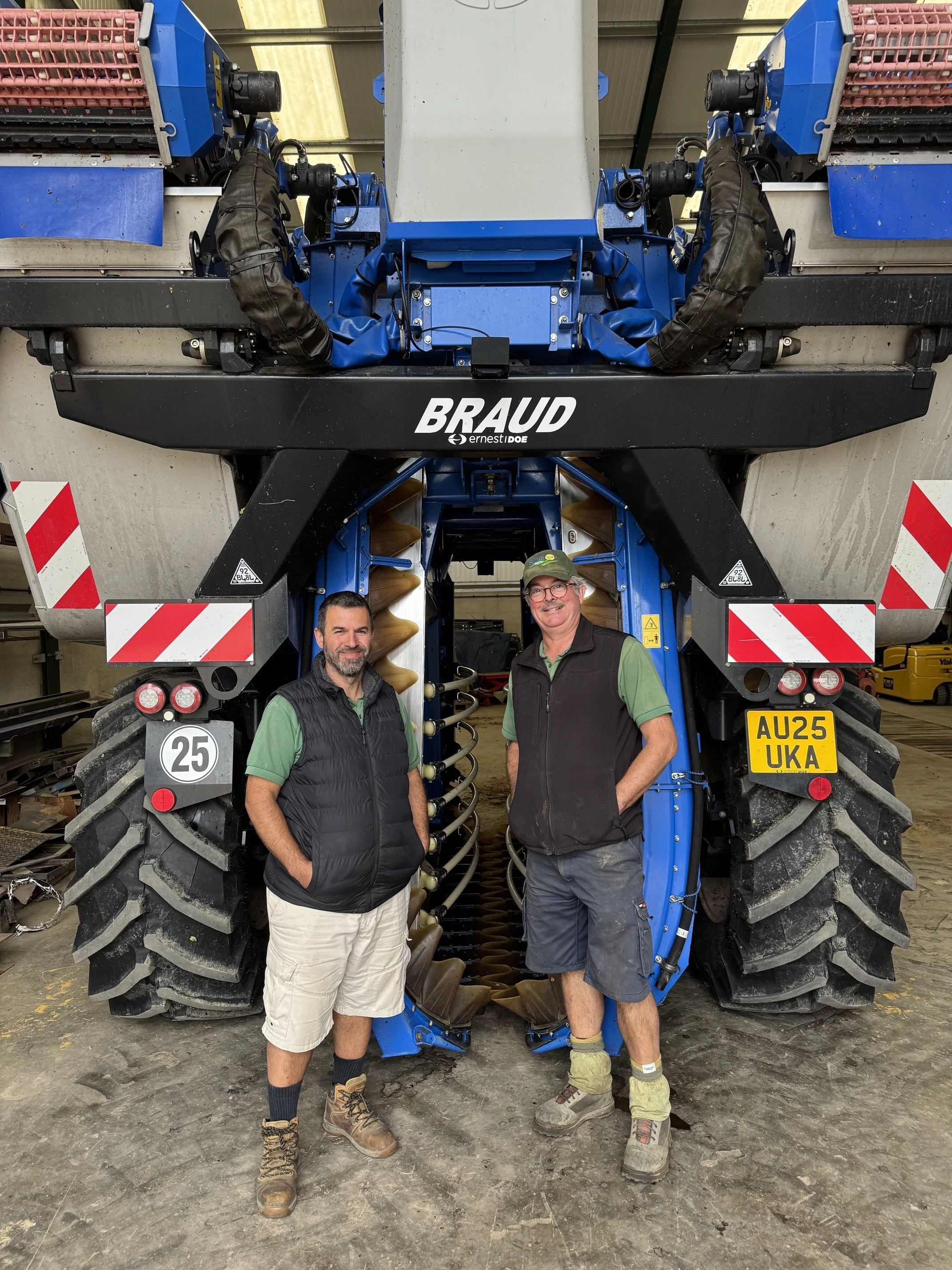
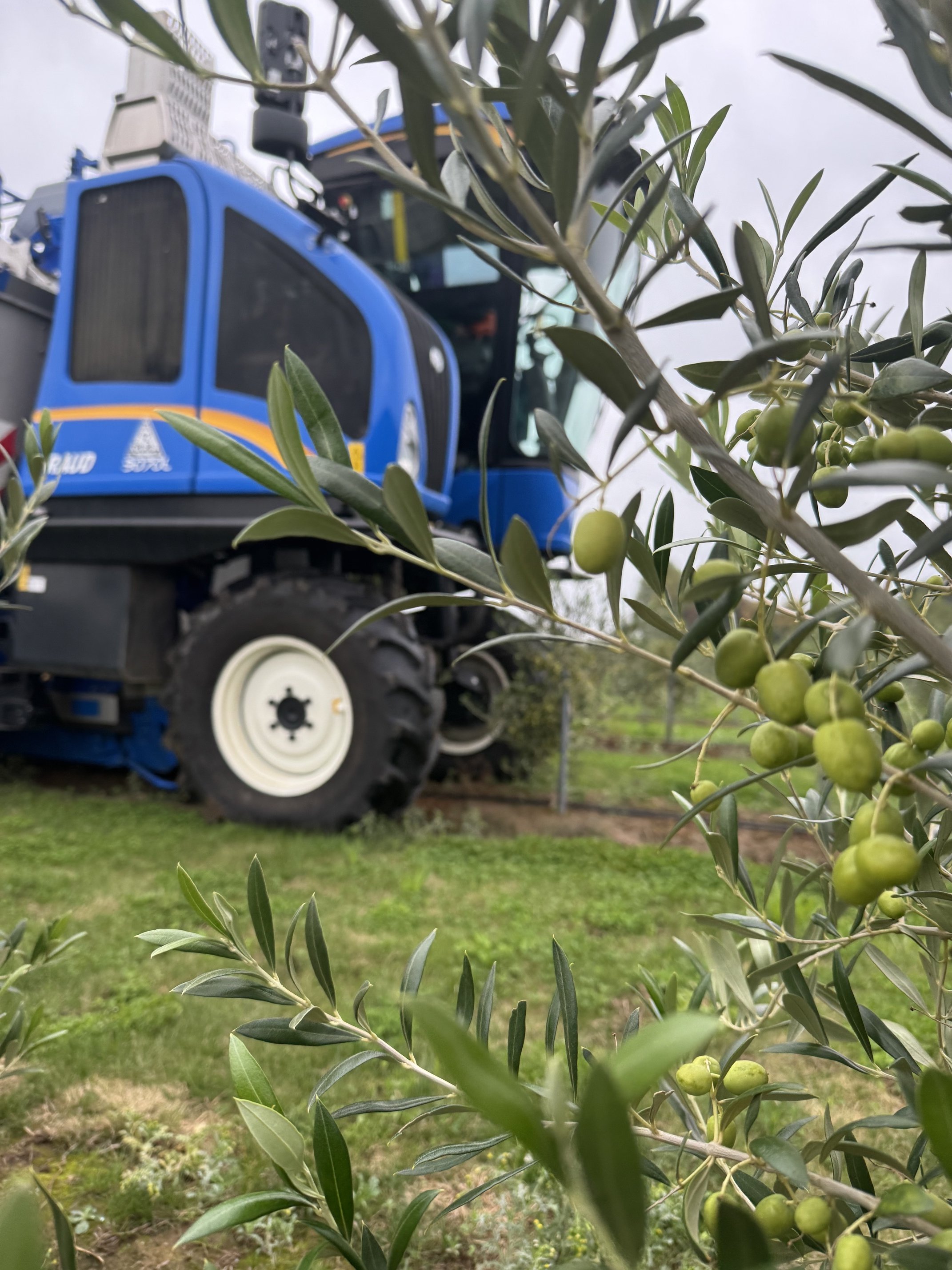
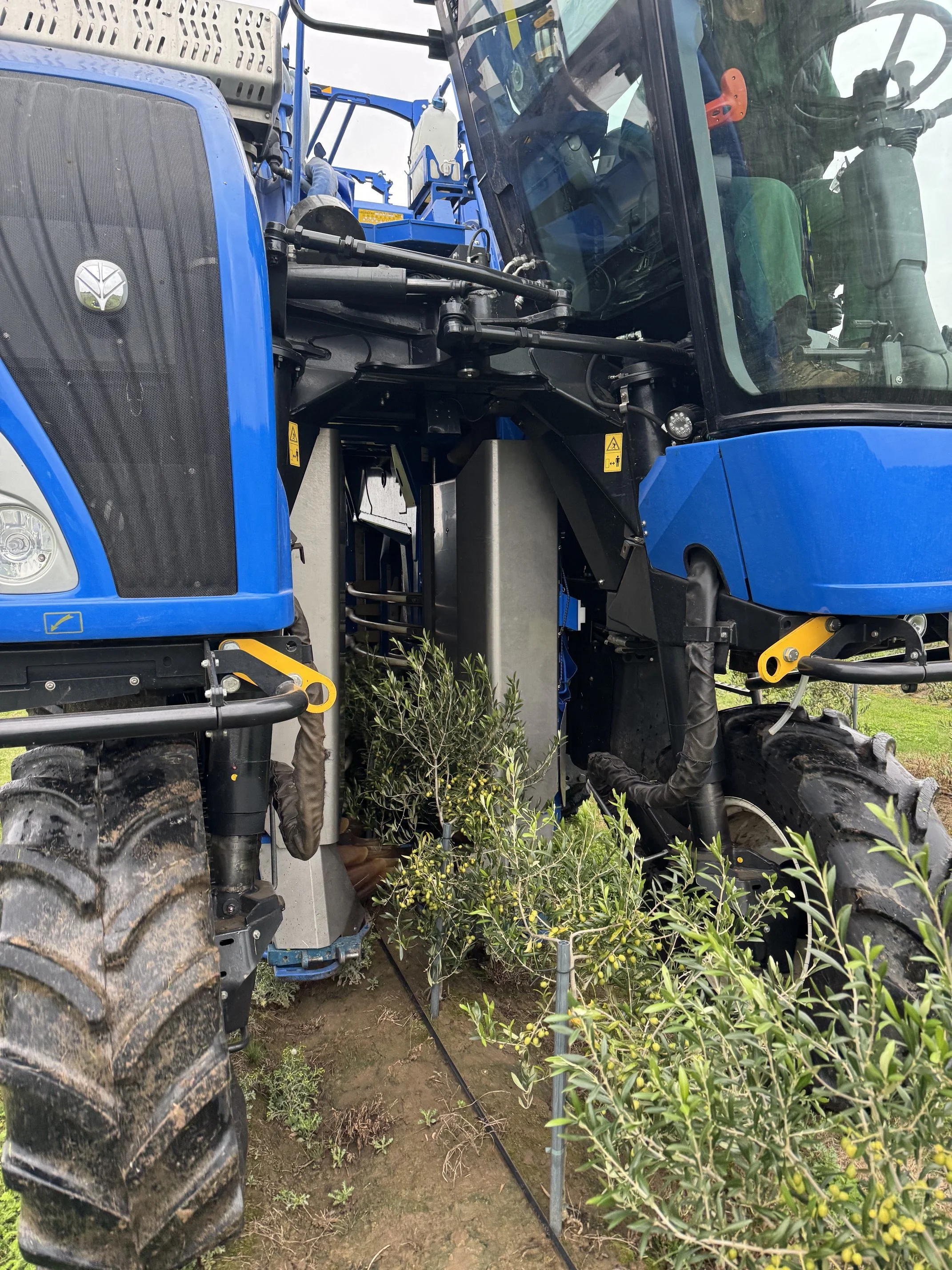
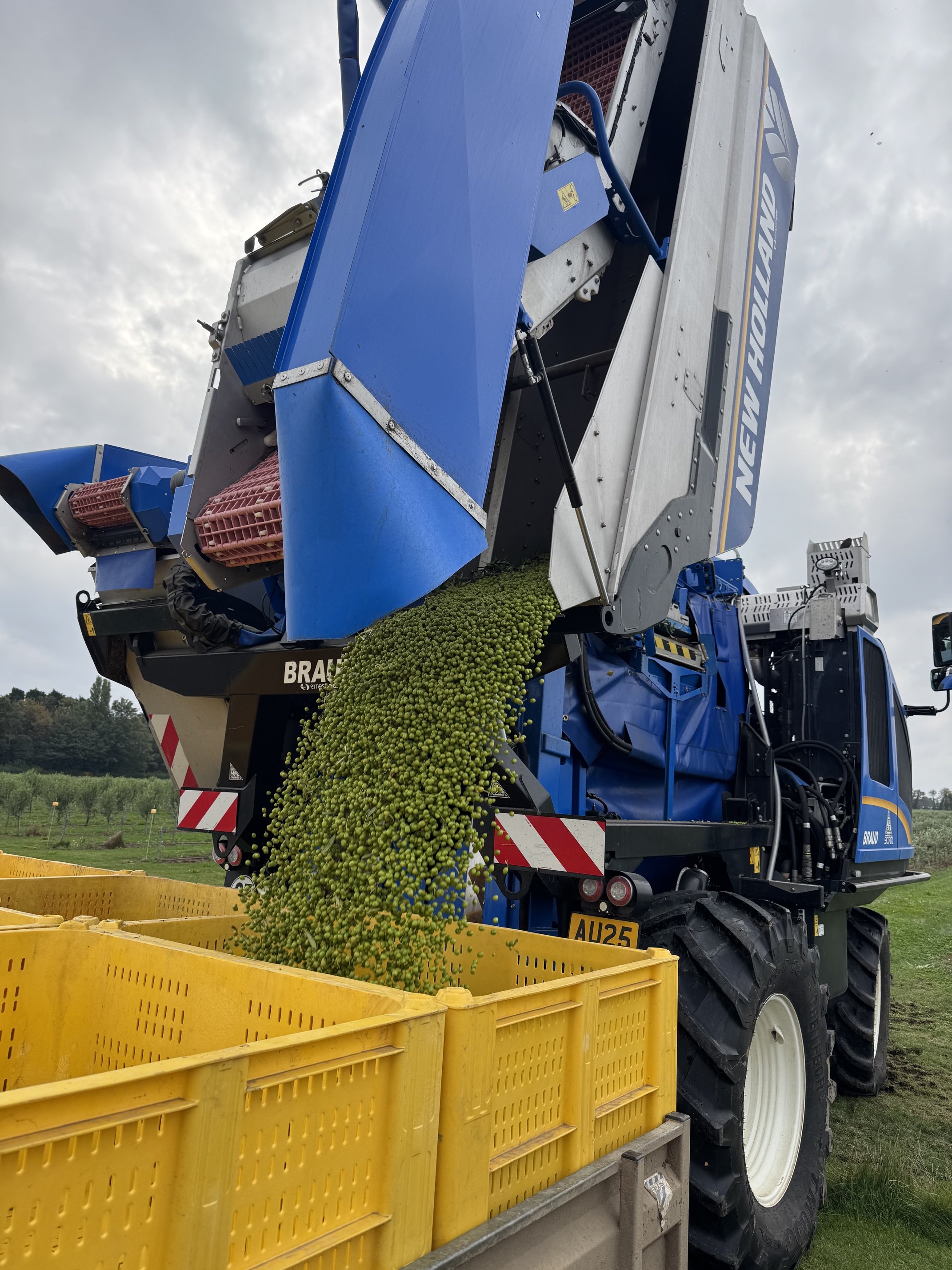
Dimi and Nigel with Nigel’s Braud 9070 NH self propelled harvester……a first for mechanical harvesting olives in the UK.
The harvested olives are brought back to the olive mill house, a few hundred meters from the olive grove, and are then washed, milled, malaxed and centrifuged to spin the oil out. Milling the olives is the term used for putting the olives through a knife block, which smashes up the olive fruit, including the stone, into small pieces. The milled fruit is then called dough, and the dough is fed into the giant stirring vessel called a malaxer. The malaxer stirs the dough until olive oil beads start to form on the top of the mix, and it this point the dough is ready to be moved into the centrifuge. The centrifuge spins the dough at many thousand reverolutions per minute, and spins out the heaviest materials first, and the lightest last. The heaviest material to come out is the stone and flesh, and this is called pomice. After the pomice water comes out, and with oil floating on top of water, then oil is the lightest, and comes out of the centrifuge last. The oil is then pumped into vessels for storage, ready to be filtered and bottled at a later date. The time the dough spends in the malaxer and in the centrifuge needs to be optimised, as oil can be lost and oil quality can also be reduced at these critical stages.
With ten different varieties of olive trees in our grove then harvest timing is spread over a couple of months to hopefully allow us to complete the job at the optimum timing for each variety. Most of our olives will be ready to harvest in November, by a mixture of community hand harvesting and more with Nigel’s Braud machine. Once most the harvest is complete we will then start the filtering and bottling, and be able to add some English Olive Oil stock to our website shop. Exciting and rewarding times for the years care and effort.
Nature regularly reminds us who is the boss, and at the end of October when the trees had many olives on them we were hit by storms Austen and Boelo with some very strong winds. The winds peaked with us at about 24m/s, which is about 55mph, and with the trees being ‘top heavy’ with quite a few olives on the branches then many hundred broke their support ties and were blown over. Most were able to be put back up and retied, but unfortunately a few trunks snapped off. We hope that from their thriving root system they will sprout new life in the spring, but time will tell. The timings off these storms was not helpful, but bad timing is never helpful!
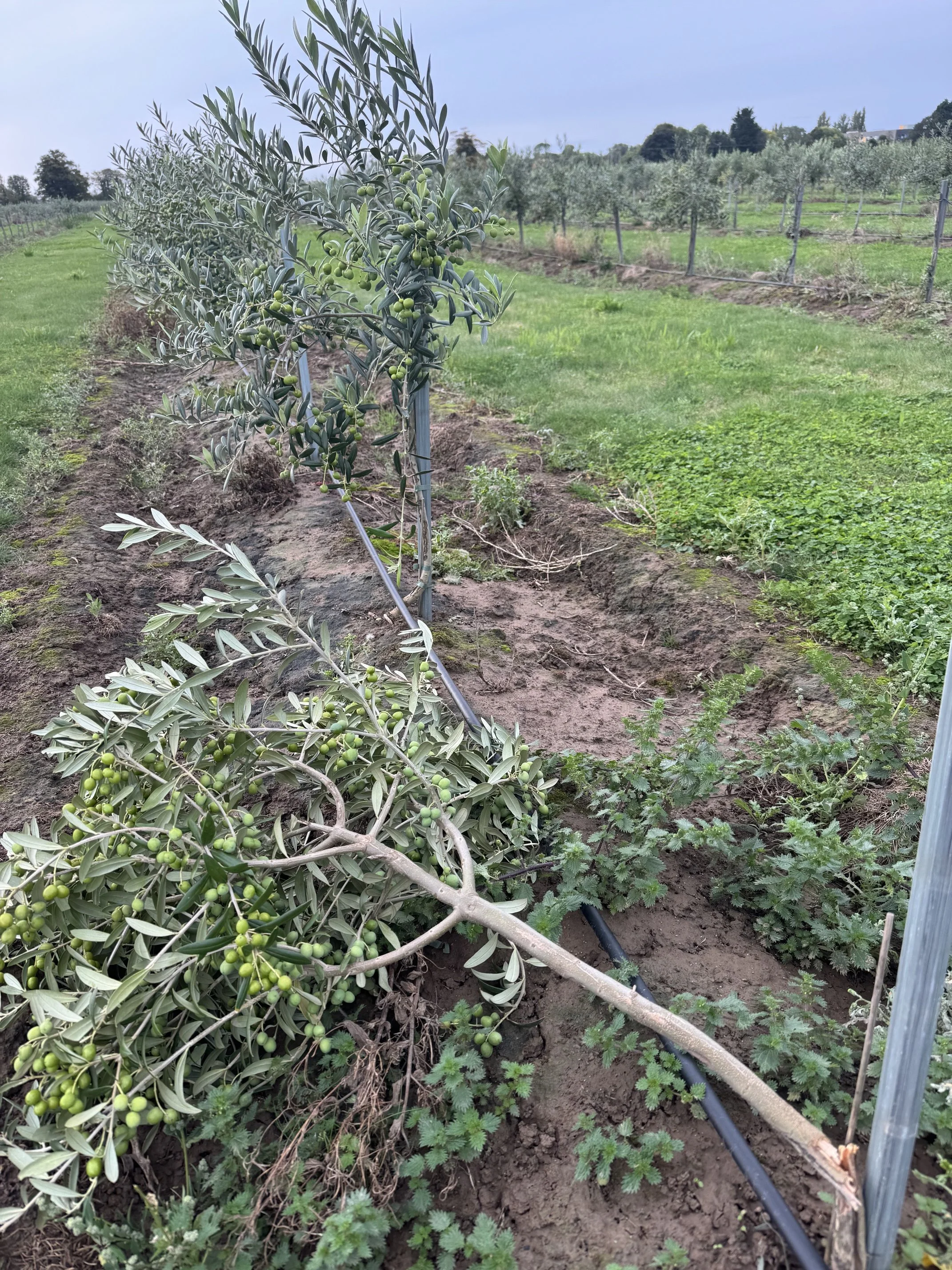
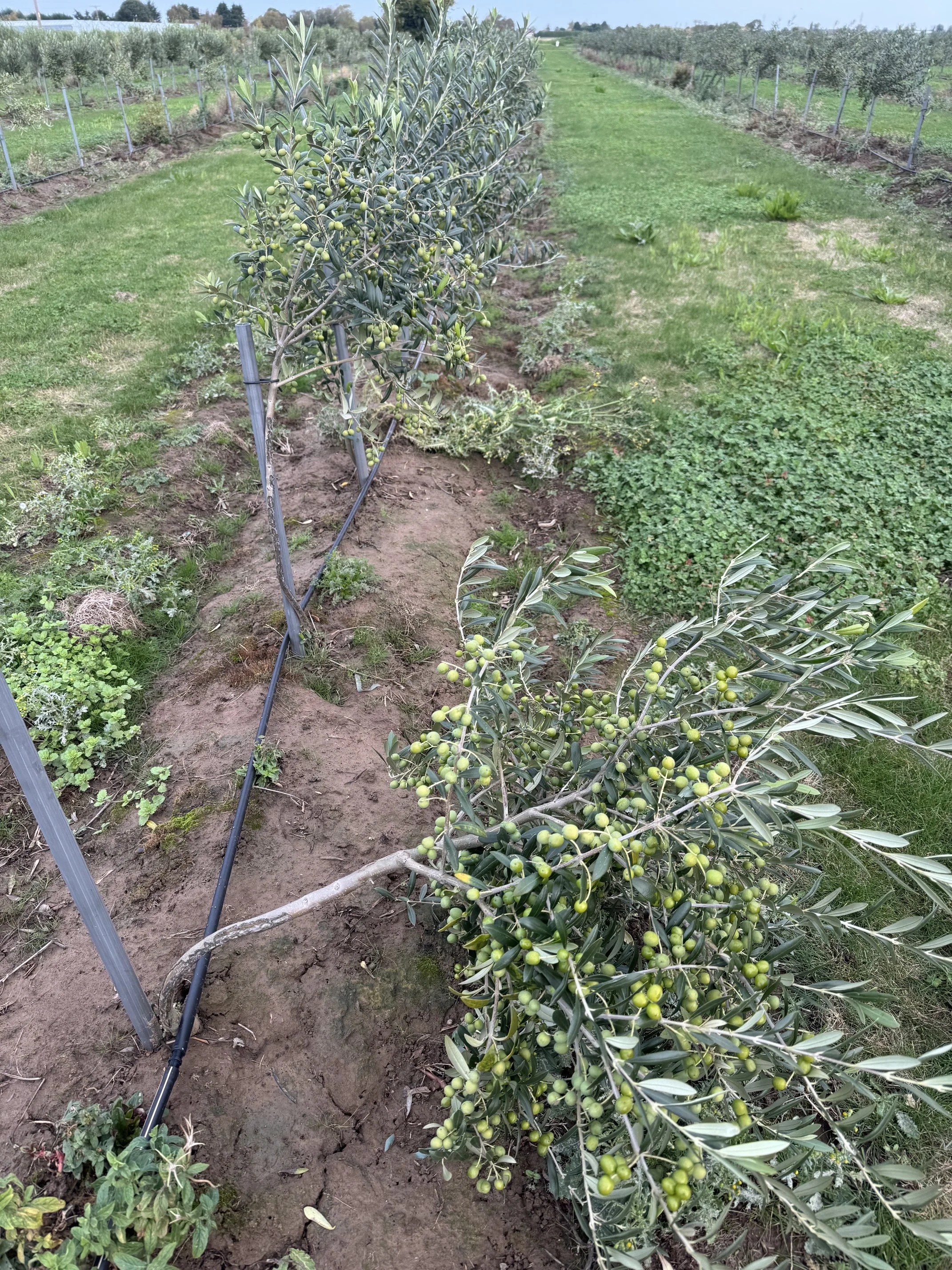
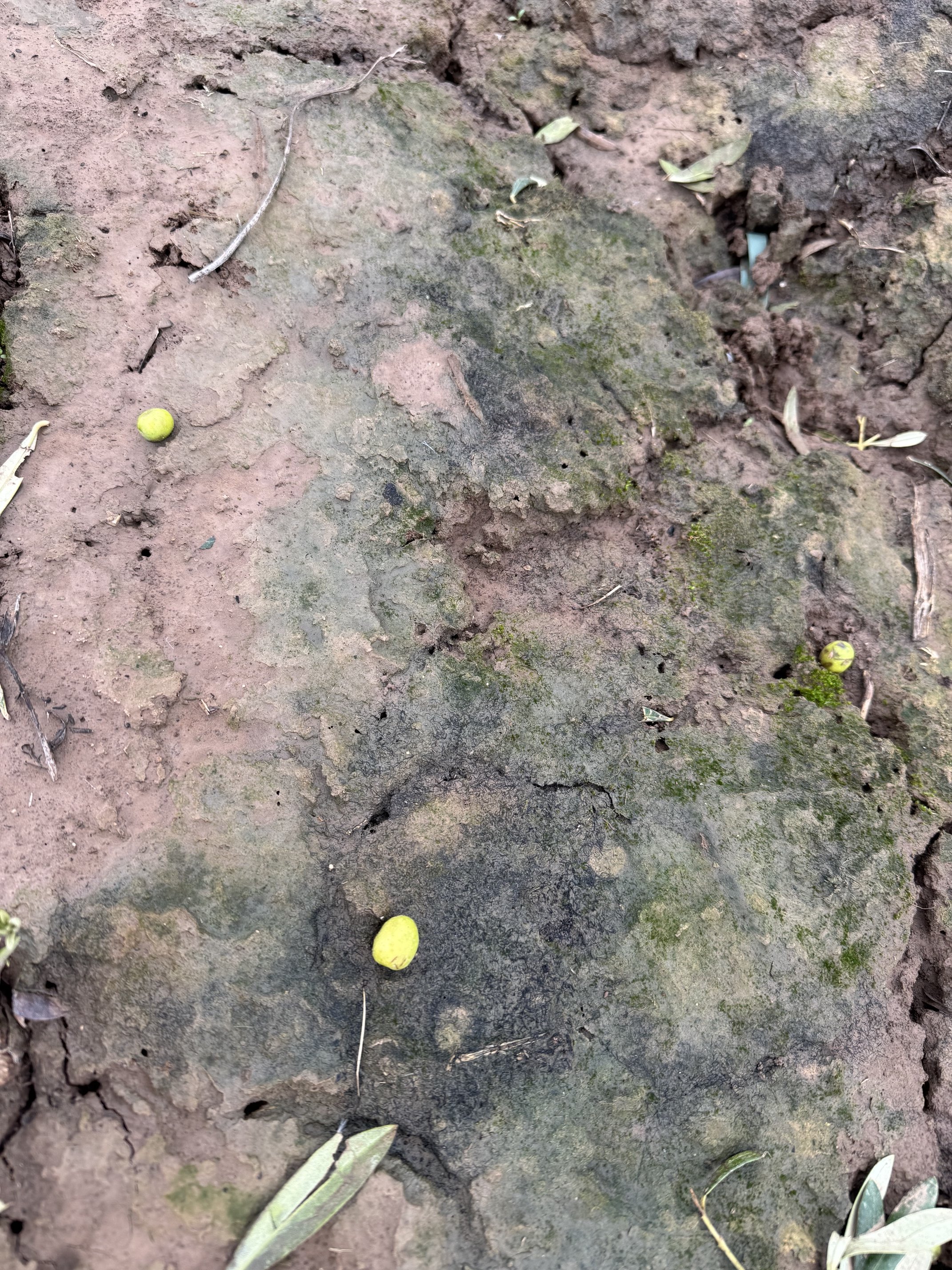
Storms Austen and Boelo knocking many hundred trees over and knocking olives off the branches.
November will be a busy month for us in the grove and in the olive mill house, as we try to safely gather the remaining varieties harvests, and then start up the bottling and labelling lines. We will let you, our Newsletter subscribers know first when we are going to add harvest 2026 English olive oil stock to our website shop, before we update others on social media.
Thank you also to all the Subscribers who have signed up for our community olive hand harvesting days at the start of November, and we look forward to meeting new faces and seeing familiar ones again. We will be in touch again if we need to add more dates!
Best wishes, David